Red Velvet Pumpkin Patch
Repose
Repose
Couldn't load pickup availability
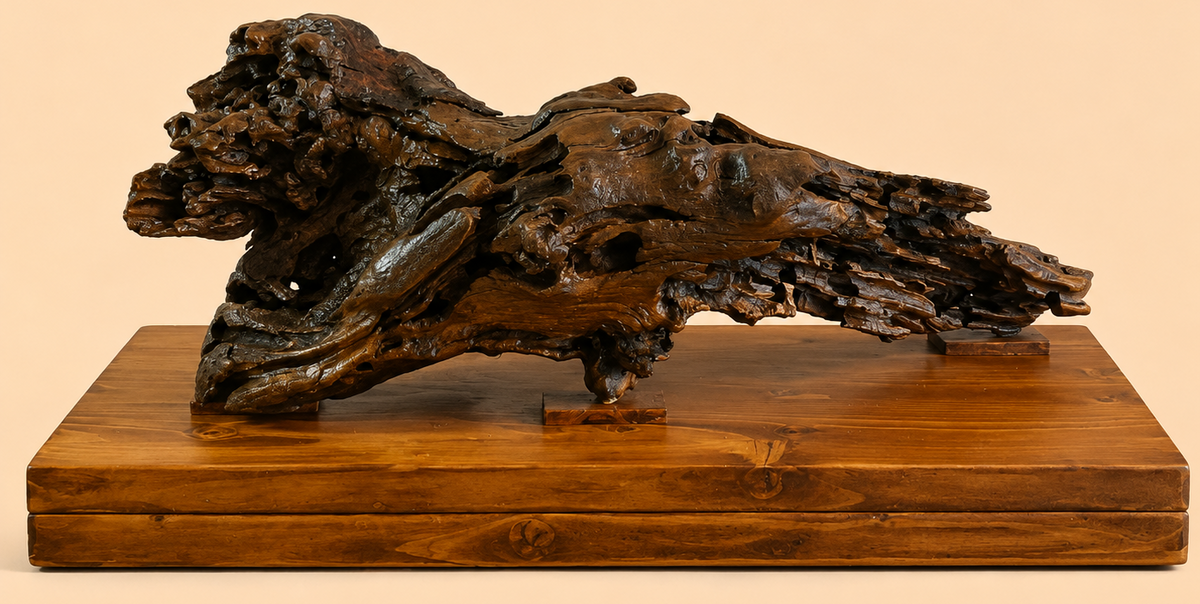
Twenty inches of driftwood lying down — not fallen, not collapsed. At rest.
It runs the full length of its base in a long low arc, rising off the wood at both ends and dipping through the middle, carried on three small blocks so it seems to hover rather than rest. One end breaks into a mass of open cells and knuckled ridges. The other tapers away almost to a point.
What it becomes depends entirely on where you stand. From one side it is a body stretched out, shoulders at one end and a leg trailing. From the other it is a wave caught at the moment it curls, or the spine of something long dead and picked clean. It reads as an animal, a landscape, and a swell of water, and it will not settle on one.
Nothing was carved. It came out of the coastal inlets of North Carolina, found on shrimping and fishing runs, hollowed and honeycombed through by years in the water. The wood is sealed in polyurethane, which brings the deep chocolate and amber up wet, and it is mounted on a long hand-built pine base finished in a warm stain.
Details
- Dimensions: 20" W × 9.125" D × 7" H, including base
- Weight: 4 lb 8 oz
- Materials: Natural driftwood sealed in polyurethane, hand-built stained pine base
- Origin: The coastal inlets of North Carolina
- Permanently mounted — the sculpture does not lift off the base
- One of a kind — this piece will not be repeated
The name is only one side
Turn this piece and it becomes something else.
That is true of everything we make, and it is the reason none of these sculptures has a front. We name each one for what we saw first — the angle that stopped us. Rotate it a quarter turn and the figure you were looking at is gone, and a different one is standing there. Ridges become a face. A wing becomes a wave. A crowd becomes one body.
So the name is our reading, not an instruction. Set it whichever way it speaks to you, and turn it again when it stops. People who live with these pieces tend to move them a few times a year without quite deciding to.
Carved by water
Not one line in this wood was cut by a blade. Every groove, hollow, and ridge was worked slowly — by salt, by tide, by years in the water — along a coast that has fed and carried people for generations. We think of these as pieces already carved by hands older than ours and left on the shore to be found.
What we do is small by comparison. We find them, we preserve them as they are, and we give them a base to stand on so they can be seen. Sometimes two pieces are set together because they belong together — but the wood itself is never cut, shaped, stained, or painted. Nothing is corrected. The wood says what it already had to say.
Care
Dust with a dry, soft cloth or a soft brush, which works better across the open cells. Keep out of direct sunlight and away from moisture. For indoor display.